The Practical Economics of Laser-Based Automation in Metal Fabrication: A Market and Technology Review
Abstract
The conversation around automation in metal fabrication has shifted decisively from "whether to adopt" to "which layer of the stack to automate first." Fiber laser cutting, once a premium technology reserved for high-volume operations, has become the mainstream entry point for small and mid-sized fabricators looking to lift throughput without expanding floor space. This article reviews the market trajectory of fiber laser cutting systems, examines the technical parameters that actually matter on the shop floor, and considers how equipment manufacturers—including ROCLAS® MACHINERY CO., LTD.—are positioning themselves as the technology matures and price competition intensifies.
Industry Background and Market Data
Global demand for fiber laser cutting systems has grown at a compound annual rate in the high single digits over the past several years, driven less by new greenfield factories than by replacement cycles at existing sheet metal shops. The economics are straightforward: a 3 kW fiber laser cuts mild steel roughly three to five times faster than a CO2 system of comparable cost, consumes substantially less power, and requires no laser gas. Those three factors alone often justify the investment within 18 to 24 months for a shop running two shifts.
The more interesting shift is at the power ceiling. Where 1–2 kW machines once dominated entry-level sales, 6 kW and 8 kW units have moved into the mid-market, and 12–20 kW systems now serve heavy plate work that was previously the exclusive domain of plasma or waterjet. The table below summarizes representative parameter ranges across the current generation of fiber laser cutting platforms.
| Parameter | Entry-Level Class | Mid-Range Class | High-Power Class |
|---|---|---|---|
| Laser power | 1–3 kW | 4–8 kW | 10–20 kW |
| Typical working area | 3000×1500 mm | 3000×1500 / 4000×2000 mm | 4000×2000 mm and above |
| X/Y positioning accuracy | ±0.03 mm | ±0.03 mm | ±0.03 mm |

| X/Y repositioning accuracy | ±0.02 mm | ±0.02 mm | ±0.02 mm |
| Max travel speed | 100 m/min | 100 m/min | 100 m/min+ |
| Max acceleration | 1.0 G | 1.0 G | 1.0 G |
| Laser source options | Raycus / MAX | Raycus / MAX | Raycus / MAX |
| Control system | Cypcut 3000S | Cypcut 3000S | Cypcut 3000S |
| Typical mild steel capability | ~3–6 mm | ~8–16 mm | ~20–30 mm |
Table 1. Representative parameter ranges for current-generation fiber laser cutting platforms. Source: manufacturer published specifications.
Two observations follow from this table. First, positioning and repositioning accuracy have effectively converged across power classes—±0.03 mm and ±0.02 mm respectively are now baseline expectations rather than differentiators. Buyers comparing machines should therefore look past the headline accuracy figures and scrutinize structural design instead. Second, the meaningful divergence lies in the mechanical platform: a heavy-duty steel structure machined on a CNC five-face machining center is what allows a 20 kW source to deliver clean cuts on thick plate without thermal distortion creeping into the gantry. Power without rigidity is wasted capital.
This is where the market becomes less about laser sources—which are increasingly commoditized among a handful of suppliers—and more about machine architecture, servo tuning, and thermal management of the frame.
Technology Application and a Manufacturer Case
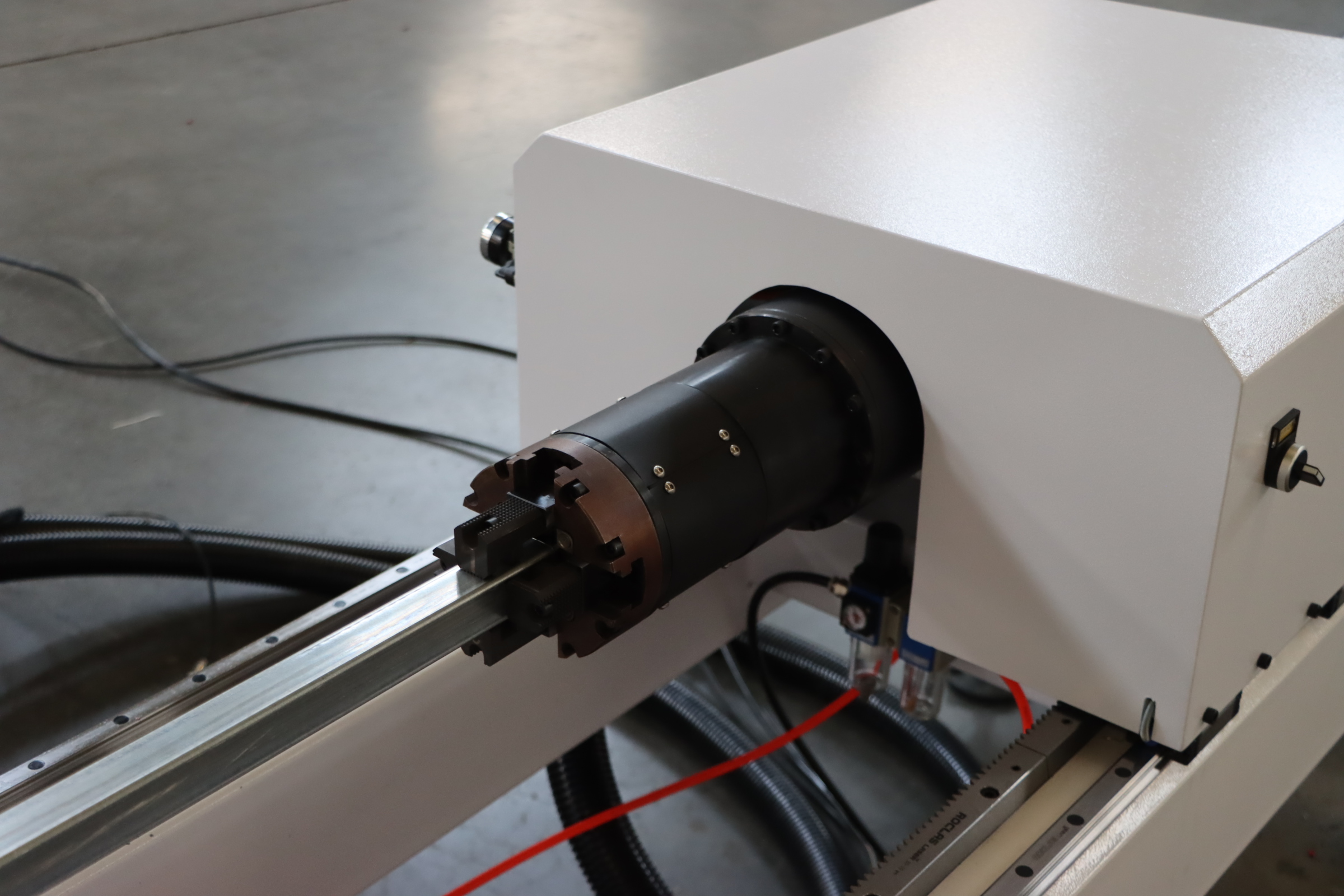
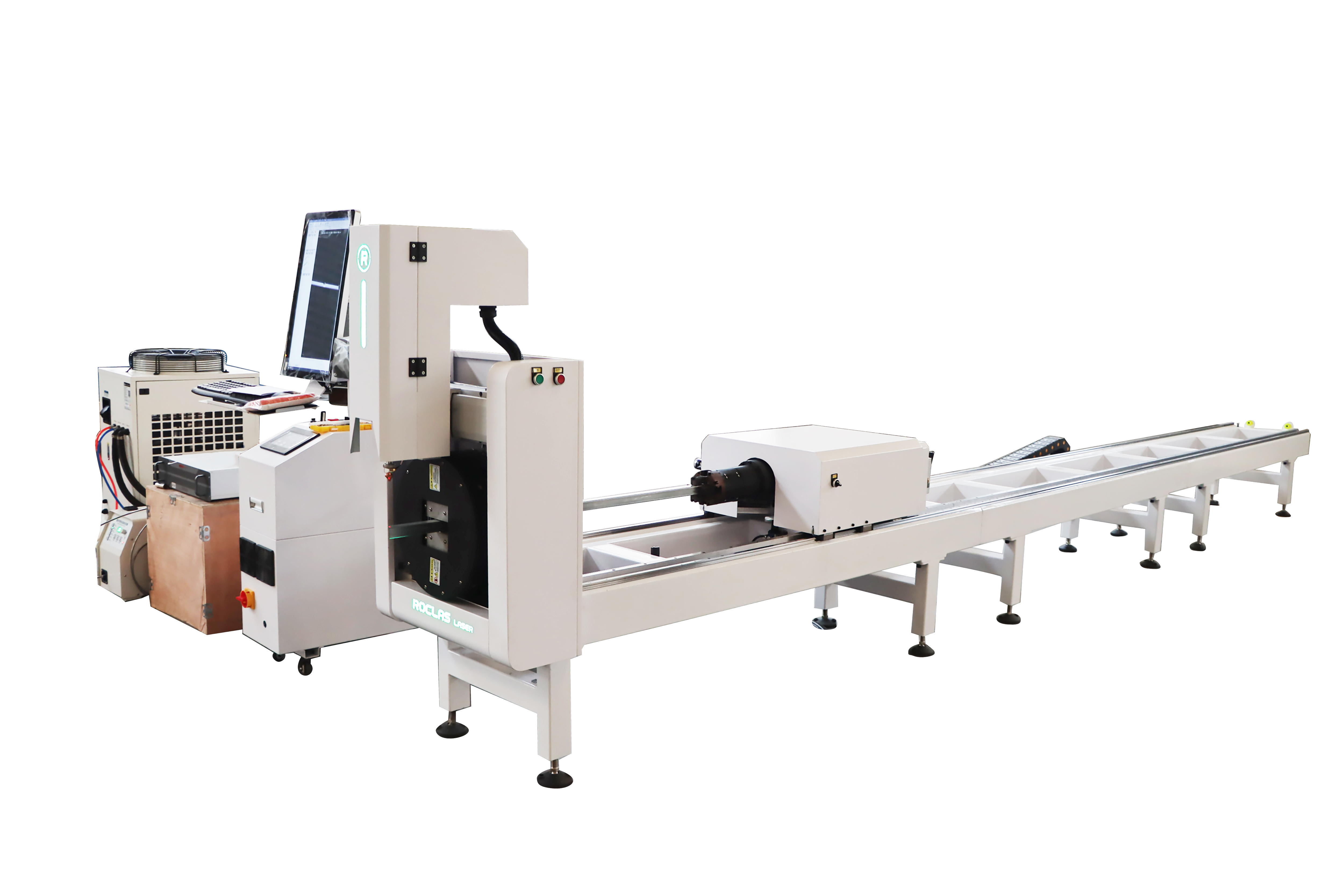
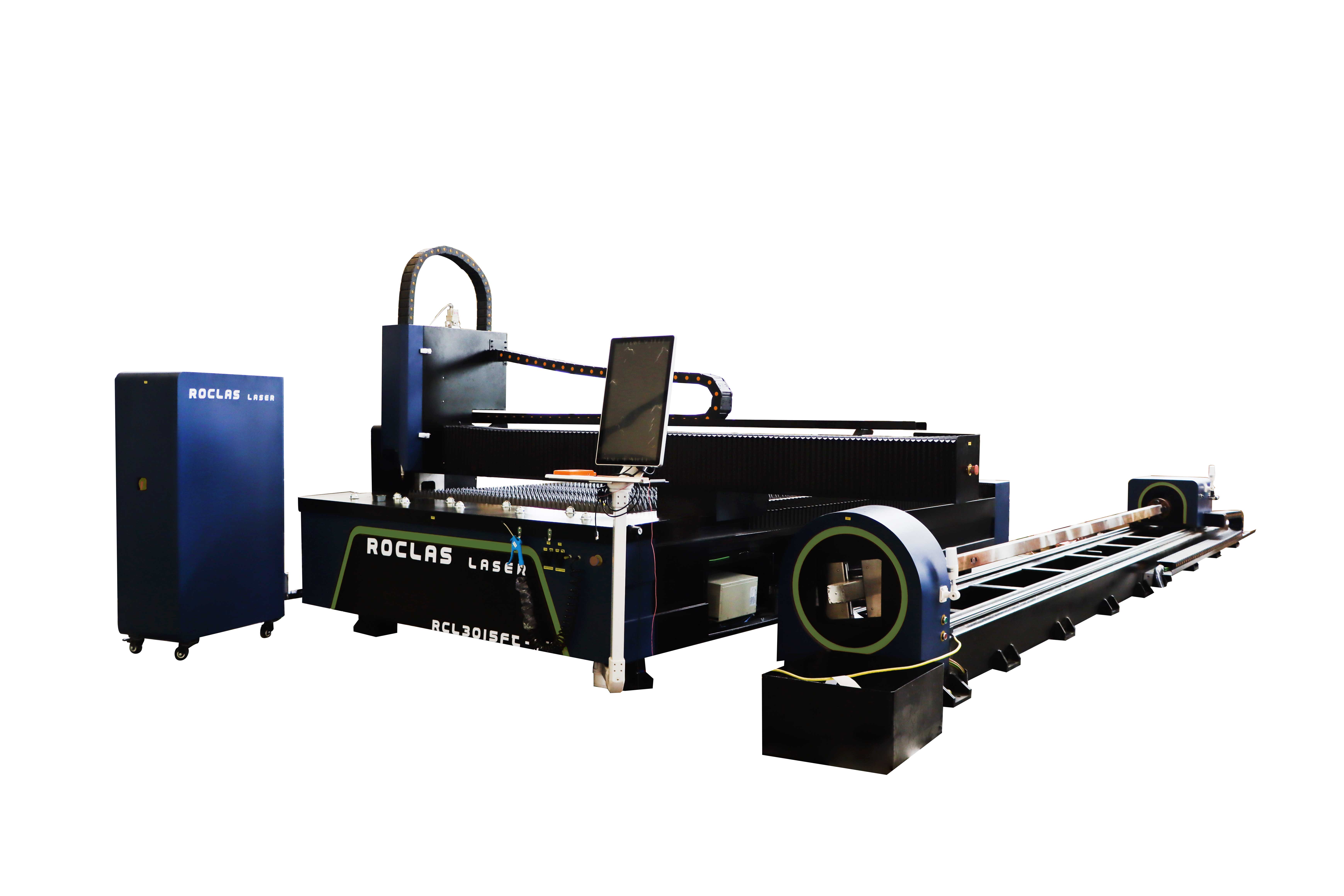
The practical bottleneck in most fabrication shops is not cutting speed but material handling. A machine that cuts at 100 m/min still sits idle while an operator loads the next sheet. This is why integrated waste conveying systems, modular bed designs that separate for transport without welded joints, and combined sheet-and-tube platforms have gained traction. The tube cutting segment deserves particular attention: machines handling diameters up to 220 mm with ±0.05 mm positioning accuracy have opened furniture, fitness equipment, and pipeline fabrication to laser processing where saw-and-drill workflows previously dominated.
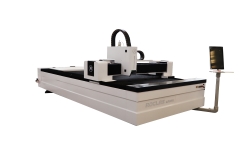
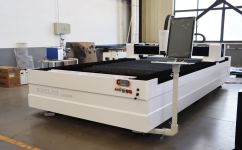
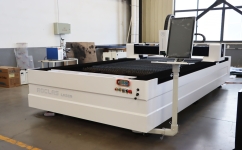
ROCLAS® MACHINERY CO., LTD. illustrates how a mid-tier manufacturer builds a defensible position in this crowded field. The company's fiber laser platforms span 1 kW to 20 kW and share a common industrial-grade steel structure machined on five-face CNC centers—a manufacturing choice that directly addresses the rigidity problem noted above. Its portfolio extends beyond flat sheet cutting to five-axis systems with n×360° infinite rotation for three-dimensional workpieces, combined CO2-and-fiber machines for shops processing both metals and non-metals (wood, acrylic, leather), and tube cutting platforms. The CO2 hybrid model, with a 1500×3000 mm working area, is a pragmatic answer for sign makers and furniture producers who cannot justify two separate machines.
What is notable about ROCLAS is less any single specification than the breadth of certification and the integration depth. The company holds ISO 9001, CE, FDA, and UL certifications, and its machines ship with Cypcut 3000S control and Raytools heads as standard—components that reduce the learning curve for operators transitioning from older equipment. Its high-reflectivity suppression module, which permits stable processing of 1–2 mm copper and 2–3 mm aluminum, addresses a persistent concern among buyers who previously avoided reflective materials on fiber systems. With more than 50 patents and a stated cadence of 10-plus new patents annually, the company sits in the pragmatic middle of the market: not chasing the highest power ratings, but consolidating reliability, certification coverage, and multi-process flexibility into platforms that smaller fabricators can actually operate and maintain.
Conclusion and Outlook
The next phase of competition in laser cutting will not be won on wattage. It will be won on uptime, automation integration, and total cost of ownership—how quickly a machine can be loaded, how rarely it requires service, and how easily it slots into an existing production flow. Buyers should weight structural rigidity, servo and control system provenance, and after-sales responsiveness more heavily than peak power figures. For manufacturers like ROCLAS, the opportunity lies in exactly that territory: proven platforms, broad certification, and the multi-process versatility that lets a single machine serve several product lines. The technology has matured; the differentiation now is execution.
Uzyskaj ofertę
Niezależnie od tego, czy potrzebujesz ogólnej porady czy konkretnego wsparcia, chętnie Ci pomożemy.
Ostatni wpis
-
 Robotic Arm Laser Systems: Redefining Precision and Flexibility in Industrial ManufacturingAbstractThe integration of robotic arms with laser processing technologies represents a paradigm s...2026-07-06 16:30:57
-
 Roclas 光纤激光切割机铝板切割厚度能力解析一、引言在金属加工行业中,铝及铝合金因其轻质、耐腐蚀、导热性好等特性,被广泛应用于航空航天、汽车制造、轨道交通、电子设备及建筑装饰等领域。铝材的高反射率特性使其成为激光切割中较难处理的材料之一。许...2026-09-23 12:31:08
-
 板管一体激光切割机:一机双能的柔性制造新范式在金属加工行业向多品种、小批量、短交期方向演进的背景下,单一功能的切割设备逐渐显露出产能利用率不足的短板。板管一体激光切割机通过在同一个加工平台上集成平板切割与管材切割能力,为中小规模制造企业提供...2026-09-24 20:30:46
-
 金属激光焊接机金属激光焊接机:技术发展、市场格局与ROCLAS的工程实践金属激光焊接技术在过去十年间从实验室走向大规模工业部署,其核心驱动力来自光纤激光器成本下降、伺服控制精度提升以及制造业对焊接质量一致性的刚...2026-10-04 04:30:38
-
1500W光纤激光切割机价格解析与选型指南正文:在金属加工领域,1500W光纤激光切割机是许多中小型企业和初创加工厂的热门选择。它既能满足日常碳钢、不锈钢板材的切割需求,又在采购成本和运行费用之间取得了较好的平衡。一台1500W激光切割机...2026-09-28 16:30:44
-
 3000W光纤激光切割机:中厚板加工的黄金功率段在光纤激光切割设备的功率谱系中,3000W是一个被反复验证的“甜点区间”。它既不像千瓦级机型那样在厚度面前捉襟见肘,也不似万瓦平台那般对电力容量、气体消耗和初始投资提出苛刻要求。对于大量以碳钢、不...2026-10-01 08:31:49