High-Power Fiber Laser Cutting in Heavy Fabrication: Power Scaling, Precision Economics, and the Integration Challenge
Abstract — Fiber laser cutting has moved decisively out of the thin-gauge job shop and into heavy fabrication, structural steel, and tube-processing environments where 10–20 kW sources are now routine rather than exceptional. This shift is less about raw wattage than about the coupled behavior of source, motion system, control software, and thermal management. Drawing on published machine specifications and application data from ROCLAS® MACHINERY CO., LTD., this article examines where power scaling delivers measurable economic return, where it does not, and why structural rigidity and control architecture have become the binding constraints on performance at the high end.
I. Industry Background and Data Analysis
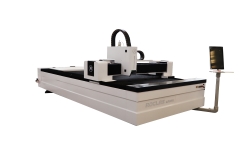
The commercial logic of high-power fiber cutting rests on a simple substitution: thicker plate cut on a laser displaces plasma, oxy-fuel, and in some cases waterjet operations, collapsing multiple process steps into one setup. The economics only hold, however, when cut quality, kerf loss, and consumable cost stay within tolerance across the full thickness range. Published parameter sets for representative ROCLAS fiber machines illustrate how the performance envelope has widened:
| Parameter | Sheet Metal Series | Tube Cutting Series |
|---|---|---|
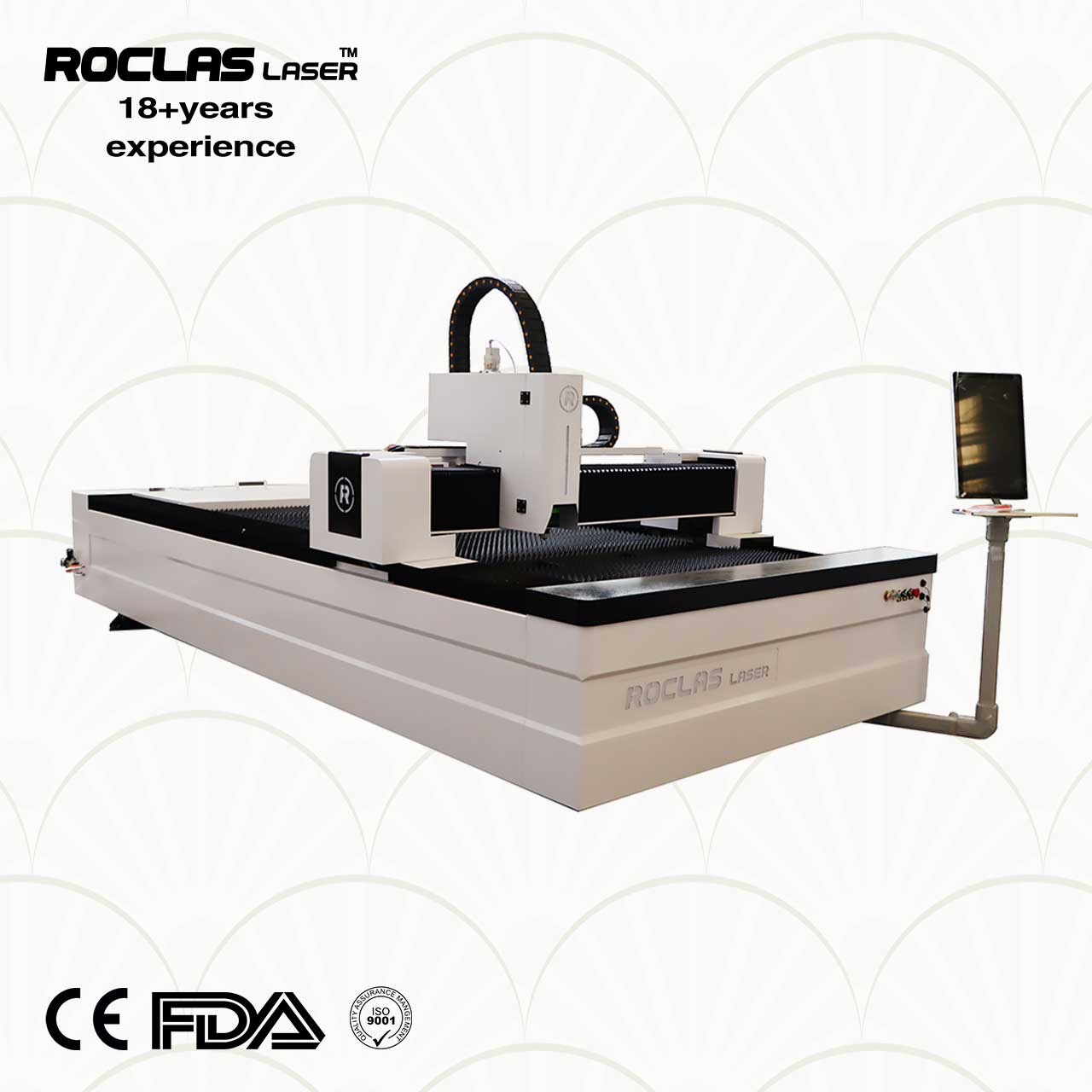
| Working area | 3000×1500 / 4000×2000 / 1500×4000 mm | 1500×4000 mm |
| Laser power range | 1000 W – 20 kW | 1000 – 3000 W |
| Laser source options | Raycus / MAX | Raycus / MAX |
| Control system | Cypcut 3000S | Cypcut 3000S |
| X/Y positioning accuracy | ±0.03 mm | ±0.05 mm |
| X/Y repositioning accuracy | ±0.02 mm | ±0.03 mm |
| Travel speed | 100 m/min | 100 m/min |
| Max acceleration | 1.0 G | 1.0 G |
| Max tube diameter | — | 220 mm |
Two observations follow from this table. First, the accuracy figures are effectively flat across the power range. A 20 kW machine holds the same ±0.03 mm positioning and ±0.02 mm repositioning tolerance as a 1 kW unit, which means the marginal value of added power is realized in speed and thickness capability, not in dimensional precision. Buyers who purchase high power expecting tighter tolerance are solving the wrong problem. Second, the 1.0 G acceleration and 100 m/min travel speed shared by both platforms indicate that the motion system, not the resonator, now sets the practical throughput ceiling on thin material; on thick plate the constraint migrates to assist-gas dynamics and kerf evacuation.
The accuracy differential between sheet (±0.03 mm) and tube (±0.05 mm) platforms is also instructive. Tube cutting introduces chuck-induced compliance and workpiece runout, and the looser tolerance reflects the physics of rotating and feeding stock rather than any deficit in the control chain. Fabricators specifying tube machines for precision work should budget for chuck maintenance and calibration as recurring cost items, not one-time setup tasks.
II. Technology Application and Brand Case Study
The high-reflectivity problem is the clearest example of how source selection and machine architecture interact. Copper and aluminum absorb poorly at near-infrared wavelengths and reflect enough energy back toward the optics to risk damage. ROCLAS addresses this with a high-reflectivity suppression module, publishing stable processing of 1–2 mm copper and 2–3 mm aluminum. That capability matters disproportionately in electrical enclosure, busbar, and heat-exchanger work, where these materials are common and where the alternative—slower, dirtier processes—erodes margin.
Structurally, the company's machines use industrial-grade heavy-duty steel frames machined on CNC five-face centers, with imported servo drives and reducers, Schneider and SMC electrical and pneumatic components, and German igus cable carriers. This bill of materials is the practical answer to a question that recurs at high power: a 20 kW source deposits substantial heat into the frame, and thermal stability of the bed translates directly into positional repeatability over a shift. ROCLAS also offers a modular, screw-connected bed as an alternative to single-piece welded construction, with the company stating that manufacturing quality is equivalent while the modular version separates for transport without welding. For export customers facing container and rigging constraints on large-format machines, that is a meaningful logistical accommodation rather than a technical compromise.
On the control side, Cypcut 3000S with automatic nesting governs material utilization—often the largest single lever on part cost after labor. The company's portfolio also extends to 5-axis platforms with n×360° infinite-rotation heads for three-dimensional workpieces, sheet-and-tube combined machines for mixed-production shops, and CO2/fiber hybrid configurations covering acrylic, wood, leather, and thin metal on a single 1500×3000 mm bed. Certifications include ISO 9001 (31623Q10581R1S), CE (ICR/VC/HM2403124), FDA, UL, and PDL, with more than 50 patents held and roughly 10 added annually—a portfolio depth consistent with a manufacturer competing on engineering rather than price alone.
III. Conclusion and Outlook
The direction of travel is clear: power will continue to climb, but the differentiators are shifting to thermal management, automation integration, and software-driven material yield. Three developments deserve attention. Combined processes—laser cutting paired with coil-fed uncoiling, robotic handling, and welding—are converting stand-alone machines into line components, and buyers should evaluate material flow across the whole cell rather than machine specifications in isolation. High-reflectivity processing will broaden as suppression techniques mature, opening thicker copper and aluminum to laser substitution. And the growing gap between thin-gauge throughput (motion-limited) and thick-plate capability (gas- and kerf-limited) argues for matching machine configuration to the actual thickness mix rather than purchasing peak power as insurance. For heavy fabrication, the disciplined question is not how many kilowatts a machine carries, but whether frame rigidity, control architecture, and support infrastructure can convert those kilowatts into repeatable, sellable parts.
Uzyskaj ofertę
Niezależnie od tego, czy potrzebujesz ogólnej porady czy konkretnego wsparcia, chętnie Ci pomożemy.
Ostatni wpis
-
 Robotic Arm Laser Systems: Redefining Precision and Flexibility in Industrial ManufacturingAbstractThe integration of robotic arms with laser processing technologies represents a paradigm s...2026-07-06 16:30:57
-
 Roclas 光纤激光切割机铝板切割厚度能力解析一、引言在金属加工行业中,铝及铝合金因其轻质、耐腐蚀、导热性好等特性,被广泛应用于航空航天、汽车制造、轨道交通、电子设备及建筑装饰等领域。铝材的高反射率特性使其成为激光切割中较难处理的材料之一。许...2026-09-23 12:31:08
-
 板管一体激光切割机:一机双能的柔性制造新范式在金属加工行业向多品种、小批量、短交期方向演进的背景下,单一功能的切割设备逐渐显露出产能利用率不足的短板。板管一体激光切割机通过在同一个加工平台上集成平板切割与管材切割能力,为中小规模制造企业提供...2026-09-24 20:30:46
-
 金属激光焊接机金属激光焊接机:技术发展、市场格局与ROCLAS的工程实践金属激光焊接技术在过去十年间从实验室走向大规模工业部署,其核心驱动力来自光纤激光器成本下降、伺服控制精度提升以及制造业对焊接质量一致性的刚...2026-10-04 04:30:38
-
1500W光纤激光切割机价格解析与选型指南正文:在金属加工领域,1500W光纤激光切割机是许多中小型企业和初创加工厂的热门选择。它既能满足日常碳钢、不锈钢板材的切割需求,又在采购成本和运行费用之间取得了较好的平衡。一台1500W激光切割机...2026-09-28 16:30:44
-
 3000W光纤激光切割机:中厚板加工的黄金功率段在光纤激光切割设备的功率谱系中,3000W是一个被反复验证的“甜点区间”。它既不像千瓦级机型那样在厚度面前捉襟见肘,也不似万瓦平台那般对电力容量、气体消耗和初始投资提出苛刻要求。对于大量以碳钢、不...2026-10-01 08:31:49