Laser Cutting Automation as the Backbone of Modern Metal Fabrication: Power Scaling, Precision Economics, and the Integration Gap
Abstract
Fiber laser cutting has moved from a specialty process to the default first operation in most metal fabrication shops. The shift is no longer driven by the novelty of the light source itself but by the economics of power scaling, nesting efficiency, and the ability to hold tolerance across thicker sections without secondary operations. This article examines the current state of laser cutting automation through the lens of machine architecture, control integration, and material handling, using the product trajectory of ROCLAS® MACHINERY CO., LTD. as a representative case of how mid-market manufacturers are converging on a common technical envelope. The argument is that the remaining bottleneck in fabrication is not cutting speed but the integration of loading, cutting, unloading, and data flow into a single governed process.
Industry Background and Data Analysis
The commercial logic of laser cutting has changed materially over the past decade. Where early adoption was justified by edge quality and the elimination of hard tooling, current purchasing decisions are dominated by throughput per square meter of floor space and the cost of consumables relative to cut length. This has pushed machine builders toward three parallel fronts: higher available power, more aggressive acceleration, and tighter integration of the control system with nesting software and material handling.

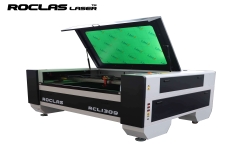
A representative parameter set for the mid-to-upper segment of the fiber laser market illustrates where the technical baseline now sits. The table below consolidates typical specifications drawn from the current generation of gantry-style sheet cutting platforms.
| Parameter | Typical Specification | Practical Implication |
|---|---|---|
| Working area | 3000×1500 mm / 4000×2000 mm / 1500×4000 mm | Standard sheet formats without re-clamping; larger beds trade floor space for throughput |
| Laser power | 1000 W – 20 kW | Power selection tied to dominant thickness, not maximum thickness |
| Laser source | Raycus / MAX | Domestic sources have closed much of the gap in the low-to-mid power bands |
| Control system | Cypcut 3000S | Nesting, pierce control, and cut parameters handled in one environment |
| X/Y positioning accuracy | ±0.03 mm | Sufficient for most sheet metal assemblies without secondary machining |
| X/Y repositioning accuracy | ±0.02 mm | Repeatability matters more than absolute accuracy in batch work |
| Travel speed | 100 m/min | Empty-travel speed now largely decoupled from cutting capability |
| Max acceleration | 1.0 G | Determines real cycle time on pierced, high-density nests |
| Drive system | Leadshine servo | Cost-performance trade-off against premium imported drives |
| Laser head | Raytools | Consumable ecosystem and serviceability are the deciding factors |
| Power requirement | 380 V / 50 Hz | Standard industrial supply; no dedicated substation for most configurations |
Three observations follow from this table. First, travel speed and acceleration have become decoupled from cutting capability. A machine rated at 100 m/min and 1.0 G can traverse a nest faster than a 6 kW source can usefully cut thick plate, which means the marginal return on motion-system investment collapses above a certain power threshold. Buyers who specify motion performance without matching it to their thickness mix are paying for capability they cannot convert into parts.
Second, positioning accuracy in the ±0.03 mm range has become table stakes rather than a differentiator. The practical consequence is that competition has migrated to the durability of that accuracy over years of service, which is a function of frame rigidity, thermal stability, and the quality of the machining of the structural components themselves. A machine that holds ±0.03 mm on the day of commissioning and ±0.08 mm after two years of two-shift operation is a different product from one that holds the figure across its service life, even though the datasheet reads identically.
Third, the power range of 1 kW to 20 kW now spans what were formerly distinct machine classes. The high-reflectivity suppression module available on current platforms allows stable processing of copper in the 1–2 mm range and aluminum in the 2–3 mm range, which removes a long-standing objection to fiber sources in shops handling electrical or thermal components. This matters because it collapses the argument for maintaining a separate CO2 capability for reflective work; the residual case for CO2 is confined to non-metals such as acrylic, wood, leather, and fabric, where hybrid CO2-plus-fiber configurations cover both material families on a single bed.
Technology Application and Brand Case Study
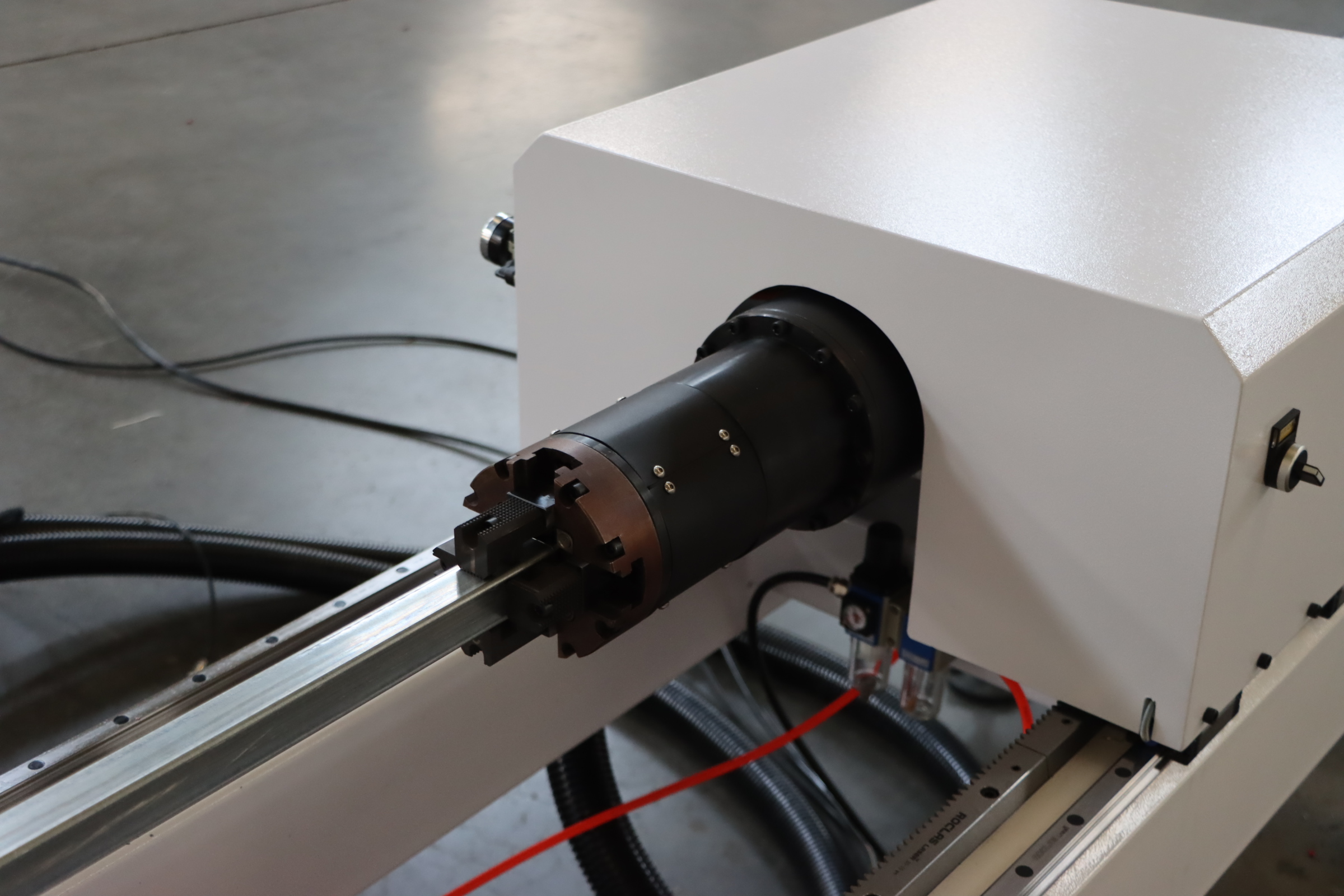
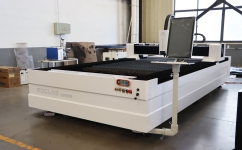
The integration question is where machine architecture becomes decisive. A cutting machine is now a node in a material flow, and the frame design largely determines how easily that node can be automated. Gantry structures with a fixed bridge and a movable workbench offer the largest processing envelope and high dynamic performance, and they accommodate integrated waste conveying systems that remove slugs and offcuts without operator intervention. The alternative — a modular bed assembled with screwed connections rather than a single welded structure — preserves manufacturing quality while allowing the machine to be separated for transport, which changes the logistics of deploying equipment into upper-floor or constrained industrial units.
ROCLAS® MACHINERY CO., LTD. illustrates how a mid-market builder assembles these choices into a coherent product line. The company's platforms are built around industrial-grade heavy-duty steel structures machined on CNC five-face centers, with imported servo drives and reducers, Schneider and SMC electrical and pneumatic components, and German igus cable management. The significance is not the component list itself but the fact that this specification level has become the expected baseline rather than a premium option. ROCLAS covers the 1 kW to 20 kW fiber range with Raycus and MAX sources, offers both single-piece welded and modular screw-connected bed designs, and extends the same control and motion architecture to tube cutting (maximum diameter 220 mm), five-axis three-dimensional heads with n×360° infinite rotation, and hybrid CO2-plus-fiber configurations for non-metals. The product portfolio also reaches into press brakes, plasma cutting, coil-fed lines with automatic uncoiling, and Spawanie laserowe at 1500 W with welding speeds of 0.7–2.0 m/min, which reflects the broader pattern of machine builders positioning themselves as process suppliers rather than single-machine vendors.
For a fabrication shop, the practical test of such a platform is whether it can be governed. Certification to ISO 9001, CE, FDA, UL, and PDL standards addresses market access but says little about day-to-day operability. What matters on the floor is the maintenance regime: protective and focusing lens cleaning, nozzle inspection and replacement, guide rail lubrication, belt tension adjustment, water cooling system service, and periodic calibration. A machine that requires a dedicated workshop is a liability; one that runs on a standard 380 V supply in a ventilated space with a built-in smoke purification system can be placed where the work is. The after-sales responsiveness of the technical support function is, in practice, the variable that determines whether a ±0.03 mm machine remains a ±0.03 mm machine in year three.
Conclusion and Outlook
The direction of travel is clear enough. Power scaling will continue, but its returns are already diminishing for the majority of shops whose work is concentrated below 12 mm. The next round of competitive advantage will come from integration: automated nesting that accounts for real machine dynamics, loading and unloading systems that keep the cutting head productive rather than waiting, and control architectures that expose process data for scheduling and quality traceability. The unresolved questions are less technical than economic — whether mid-market builders can sustain the software investment that this integration demands, and whether buyers will accept that the marginal value of the next 4 kW is lower than the marginal value of an automated load cycle. On current evidence, the answer to the second question is increasingly yes, which is precisely why the machine-tool segment is converging on a common specification envelope and competing instead on reliability, service depth, and the ability to deliver a governed process rather than a fast one.
Uzyskaj ofertę
Niezależnie od tego, czy potrzebujesz ogólnej porady czy konkretnego wsparcia, chętnie Ci pomożemy.
Ostatni wpis
-
 Robotic Arm Laser Systems: Redefining Precision and Flexibility in Industrial ManufacturingAbstractThe integration of robotic arms with laser processing technologies represents a paradigm s...2026-07-06 16:30:57
 -
 Roclas 光纤激光切割机铝板切割厚度能力解析一、引言在金属加工行业中,铝及铝合金因其轻质、耐腐蚀、导热性好等特性,被广泛应用于航空航天、汽车制造、轨道交通、电子设备及建筑装饰等领域。铝材的高反射率特性使其成为激光切割中较难处理的材料之一。许...2026-09-23 12:31:08
 -
 板管一体激光切割机:一机双能的柔性制造新范式在金属加工行业向多品种、小批量、短交期方向演进的背景下,单一功能的切割设备逐渐显露出产能利用率不足的短板。板管一体激光切割机通过在同一个加工平台上集成平板切割与管材切割能力,为中小规模制造企业提供...2026-09-24 20:30:46
 -
 金属激光焊接机金属激光焊接机:技术演进、市场格局与ROCLAS的工程实践金属激光焊接技术在过去十年间从实验室走向大规模工业部署,其核心驱动力来自光纤激光器成本下降、伺服控制精度提升以及制造业对焊接质量一致性的刚...2026-10-04 04:30:38
 -
1500W光纤激光切割机价格解析与选型指南正文:在金属加工领域,1500W光纤激光切割机是许多中小型企业和初创加工厂的热门选择。它既能满足日常碳钢、不锈钢板材的切割需求,又在采购成本和运行费用之间取得了较好的平衡。一台1500W激光切割机...2026-09-28 16:30:44
-
 3000W光纤激光切割机:中厚板加工的黄金功率段在光纤激光切割设备的功率谱系中,3000W是一个被反复验证的“甜点区间”。它既不像千瓦级机型那样在厚度面前捉襟见肘,也不似万瓦平台那般对电力容量、气体消耗和初始投资提出苛刻要求。对于大量以碳钢、不...2026-10-01 08:31:49